
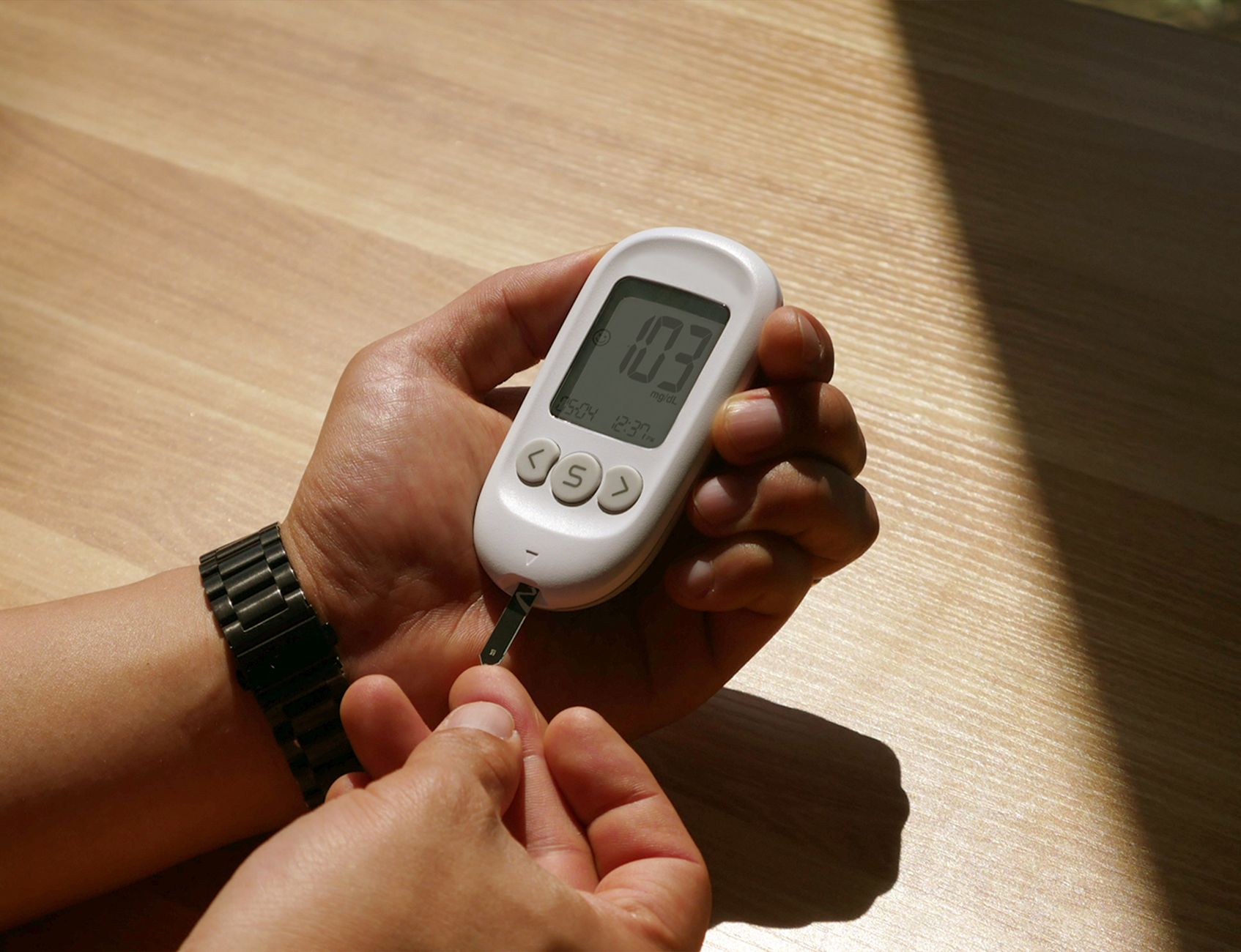
Feed two people the exact same slice of white bread and one of them will spike almost twice as hard as the other. Same bread, same grams of carbohydrate, wildly different blood sugar. That was one of the quieter findings from an 800-person study that strapped continuous glucose monitors to people for a week and logged nearly 47,000 meals, and it undercuts the whole idea that a food has a fixed glycemic value for everyone Cell, 2015.
Your response to food is personal. Your annual bloodwork can’t see any of it.
The number your doctor checks, and the story it leaves out
A fasting glucose is a single snapshot taken after you haven’t eaten for eight hours. HbA1c is an average of roughly the last three months, estimated from how much sugar has stuck to your red blood cells. Both are genuinely useful. Both are also low-resolution.
Averaging is the problem. Someone whose glucose sits calmly at 95 all day can post the same HbA1c as someone who lives on a rollercoaster, plunging to 70 and rocketing to 180 after lunch. On paper they look identical. Their days inside their own bloodstream are not.
A continuous glucose monitor (CGM) is a coin-sized sensor with a filament sitting in the fluid just under your skin, sampling glucose every few minutes. It doesn’t measure blood directly, so it lags real blood sugar by five to ten minutes and it wanders a bit at the extremes. But it turns that one morning snapshot into a 24-hour movie, and the movie shows things the snapshot can’t: how high you climb after oatmeal, how long you stay elevated, whether a poor night’s sleep flattens your morning tolerance.
What the spikes are actually doing
A post-meal rise is normal. Carbohydrate breaks down to glucose, glucose enters the blood, insulin rises, tissues pull it out of circulation, and within a couple of hours you’re back to baseline. That’s a healthy system doing its job.
The question is the shape of the curve. A sharp climb followed by a fast drop means your pancreas had to shout to get the message across, and the overshoot of insulin can drag you below where you started, which is the shaky, hungry, foggy feeling an hour after a big pasta lunch. Sustained high glucose is where the damage lives. Sugar is chemically sticky. Given time and concentration, it bonds to proteins in your blood vessels, your kidneys, the lens of your eye, in a process called glycation, and those modified proteins don’t work the way clean ones do. HbA1c is literally a measurement of that stickiness on your hemoglobin.
Here’s the part that matters for people who aren’t diabetic yet. Insulin resistance builds quietly for years before fasting glucose ever budges, because the pancreas compensates by pumping out more insulin to keep that fasting number looking respectable. The spikes often show strain before the fasting value cracks.
Where the fasting number stops being reassuring
| Marker | Normal | Prediabetes | Diabetes |
|---|---|---|---|
| Fasting glucose | Below 100 mg/dL | 100 to 125 | 126 or higher |
| HbA1c | Below 5.7% | 5.7 to 6.4% | 6.5% or higher |
| 2-hour glucose (after 75g) | Below 140 mg/dL | 140 to 199 | 200 or higher |
These are the standard diagnostic cutoffs. Notice how a person can sit at a fasting glucose of 98 and an HbA1c of 5.6%, textbook normal on both, and still blow past 180 two hours after a meal. The oral glucose tolerance test catches this, which is exactly why obstetricians use it in pregnancy instead of trusting fasting numbers alone. Most of us never get one.
What a week of watching your own curves teaches
You don’t need a CGM forever, and for most healthy people two weeks is plenty to learn your patterns. What tends to jump out:
Meal order changes the peak. Eating your vegetables and protein before the starch, rather than diving into the rice first, meaningfully blunts the post-meal rise. In a small crossover trial, the same meal eaten carbs-last produced lower glucose and insulin than carbs-first Diabetes Care, 2015. Fiber and protein slow gastric emptying, so the sugar arrives as a trickle instead of a flood. More on why fiber does the heavy lifting in /fuel/the-fiber-gap.
A walk is the cheapest insulin sensitizer you own. Ten to fifteen minutes of easy movement after eating pulls glucose into working muscle through a channel that doesn’t even require insulin. You will watch a would-be spike get sanded flat in real time.
Sleep and stress leak into your glucose. A short night or a brutal Monday can raise your baseline and steepen your response to identical food, because cortisol tells the liver to dump glucose. The CGM makes that connection undeniable in a way a lecture never will.
Liquid sugar is a different animal. Juice and soda hit fast and hard because there’s no fiber or fat to slow them. The curve looks like a spike on a heart monitor.
None of this is exotic. The value is that you stop guessing which advice applies to you. Maybe you tolerate rice fine and get wrecked by grapes. The monitor tells you instead of a food blog telling you.
Where the evidence runs out
Here’s the honest edge of this. We have excellent evidence that lifestyle change prevents diabetes in people at high risk. In the Diabetes Prevention Program, a program of modest weight loss and 150 minutes of weekly activity cut progression to type 2 diabetes by 58%, beating metformin NEJM, 2002. That is rock solid.
What we do not yet have is proof that a healthy, non-diabetic person wearing a CGM and chasing flatter curves lives longer or healthier because of it. The studies showing that spikes correlate with cardiovascular risk are observational, and much of the CGM enthusiasm has run ahead of the outcome data. Optimizing a number is not the same as optimizing your life, and there’s a real failure mode where someone becomes so anxious about a harmless post-banana bump that they cut out fruit. That’s the tail wagging the dog.
Use a CGM as a two-week teacher, not a lifelong scold. Learn your patterns, keep the three or four habits that obviously help, and stop staring at the graph. If your fasting glucose is creeping into the 100s, or your HbA1c past 5.7%, that’s not a wearable question, that’s a conversation with a doctor and probably a serious look at your training. Strength work and hard intervals both improve how your muscle handles glucose, which is half of why /train/hiit-after-40-work-harder-not-longer earns its place.
The most useful thing a CGM does isn’t the number. It’s that it makes an invisible system visible for long enough that you finally believe the boring advice, because you watched it work on your own arm.