
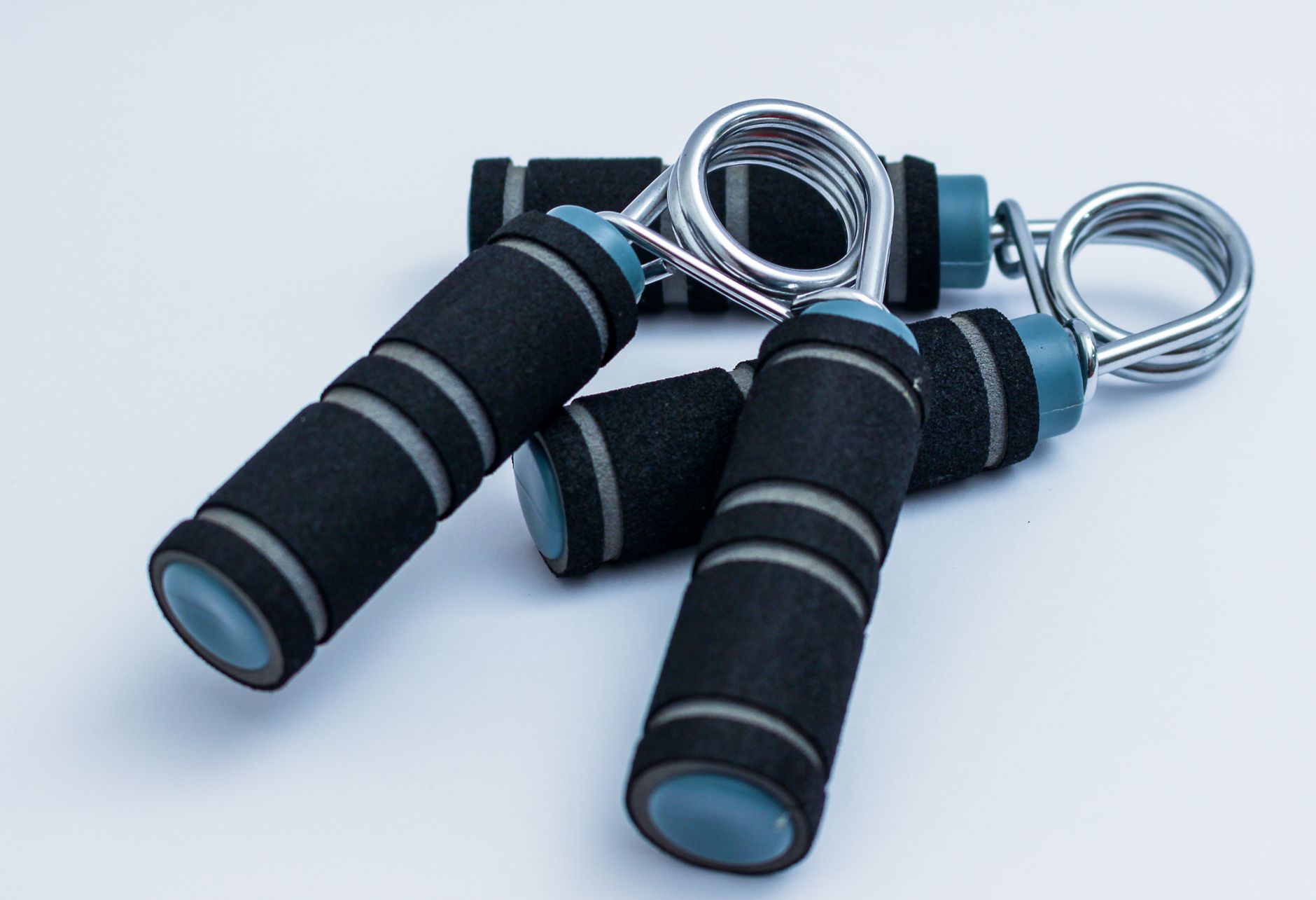
In a study of nearly 140,000 people across 17 countries, how hard you could squeeze a handle turned out to be a stronger predictor of death than your systolic blood pressure. Not a proxy for it. Stronger than it.
That finding comes from the PURE study, and it reframes what a hand dynamometer actually measures. A grip test looks like it measures your forearms. It doesn’t. It measures something much closer to your biological age.
What squeezing a handle actually tells you
Grip strength is a cheap window into your total muscular system. The muscles that close your hand are downstream of the same things that govern the muscles that get you off the toilet at 85: motor neuron health, muscle mass, protein turnover, and the nervous system’s ability to recruit fibers on command. When those systems decline, they tend to decline together. Grip is just the easiest one to measure without a lab.
That is why it behaves like a whole-body barometer rather than a local one. A weak grip is rarely a hand problem. It is usually a sign that sarcopenia, the age-related loss of muscle, is already underway somewhere you can’t see, and that your capacity to buffer illness, surgery, and falls has quietly shrunk.
The evidence, and how strong it is
The headline data come from the Prospective Urban Rural Epidemiology (PURE) study, which tracked 139,691 adults for roughly four years. Every 5 kilogram drop in grip strength was associated with a 16% higher risk of all-cause death, a 17% higher risk of cardiovascular death, and meaningfully higher risk of heart attack and stroke (Lancet, 2015). Grip predicted death more accurately than systolic blood pressure in that cohort.
Read that carefully, though. This is an observational cohort, so it shows association, not cause. Squeezing harder does not directly stop a heart attack. What grip does is expose the underlying condition of your body with unusual efficiency, the way a single blood test can flag a problem it doesn’t create. The reverse-causation trap is real too: people who are already sick, sedentary, or losing muscle test weak, and they were going to fare worse anyway.
Where the evidence is genuinely solid is as a marker. European consensus criteria now use low grip strength as a primary screening tool for sarcopenia, with clinical cutoffs of under 27 kg for men and under 16 kg for women (Age Ageing, 2019). Fall below those and clinicians treat it as a red flag worth investigating.
Where you actually stand
Grip drops with age and differs sharply by sex, so a raw number means little without context. These are rough population averages for the dominant hand, measured with a handheld dynamometer. Use them as orientation, not a diagnosis.
| Age | Men (kg) | Women (kg) |
|---|---|---|
| 20-29 | 46 | 29 |
| 30-39 | 45 | 28 |
| 40-49 | 43 | 27 |
| 50-59 | 40 | 25 |
| 60-69 | 35 | 22 |
| 70+ | 28 | 18 |
If you are a 55-year-old man pulling 30 kg, you are not at the clinical cutoff, but you are tracking a decade or two ahead of where you’d want to be. That is useful information you can act on now, while the gap is small.
What to do on Monday
First, get a number. A basic hand dynamometer costs about 30 dollars. Test both hands, take the best of three squeezes each, and write it down. Retest every three months. A single reading tells you where you are; the trend tells you where you’re going, and the trend is the part you control.
Then train the thing grip is a proxy for, which is systemic strength, not just forearms. The most efficient movers:
- Loaded carries. Pick up two heavy dumbbells or a loaded trap bar and walk. Farmer’s carries hammer grip, core, and posture simultaneously.
- Deadlifts and rows without lifting straps, at least on your warm-up sets, so your hands do the work your back is doing.
- Dead hangs from a pull-up bar. Just hang. Work up to 60 seconds. This is one of the few exercises that also decompresses the shoulders while it builds grip endurance.
Grip responds to training quickly because much of early strength gain is neurological, your nervous system learning to recruit fibers it was ignoring. You will often see a measurable bump in weeks. If you are building a broader program, the same principles that raise grip raise everything else, and we cover the framework in strength training after 40.
Where this stops being useful
Grip strength is a smoke detector, not a treatment. Chasing a bigger grip number in isolation, with wrist curls and squeeze gadgets, misses the point entirely. You can build an impressive crush grip and still be losing leg muscle, which is the mass that actually keeps you independent and out of a care home. The value of the test is that it flags a problem cheaply; the fix is training your whole body and eating enough protein to rebuild it.
It is also a lagging indicator. By the time your grip has fallen below the sarcopenia cutoff, you have already lost years of muscle you’d rather have kept. Which is the real argument for testing in your 40s and 50s, when the number is still good and the reading is a warning instead of a diagnosis. The best time to know your grip is before it has anything alarming to tell you.