
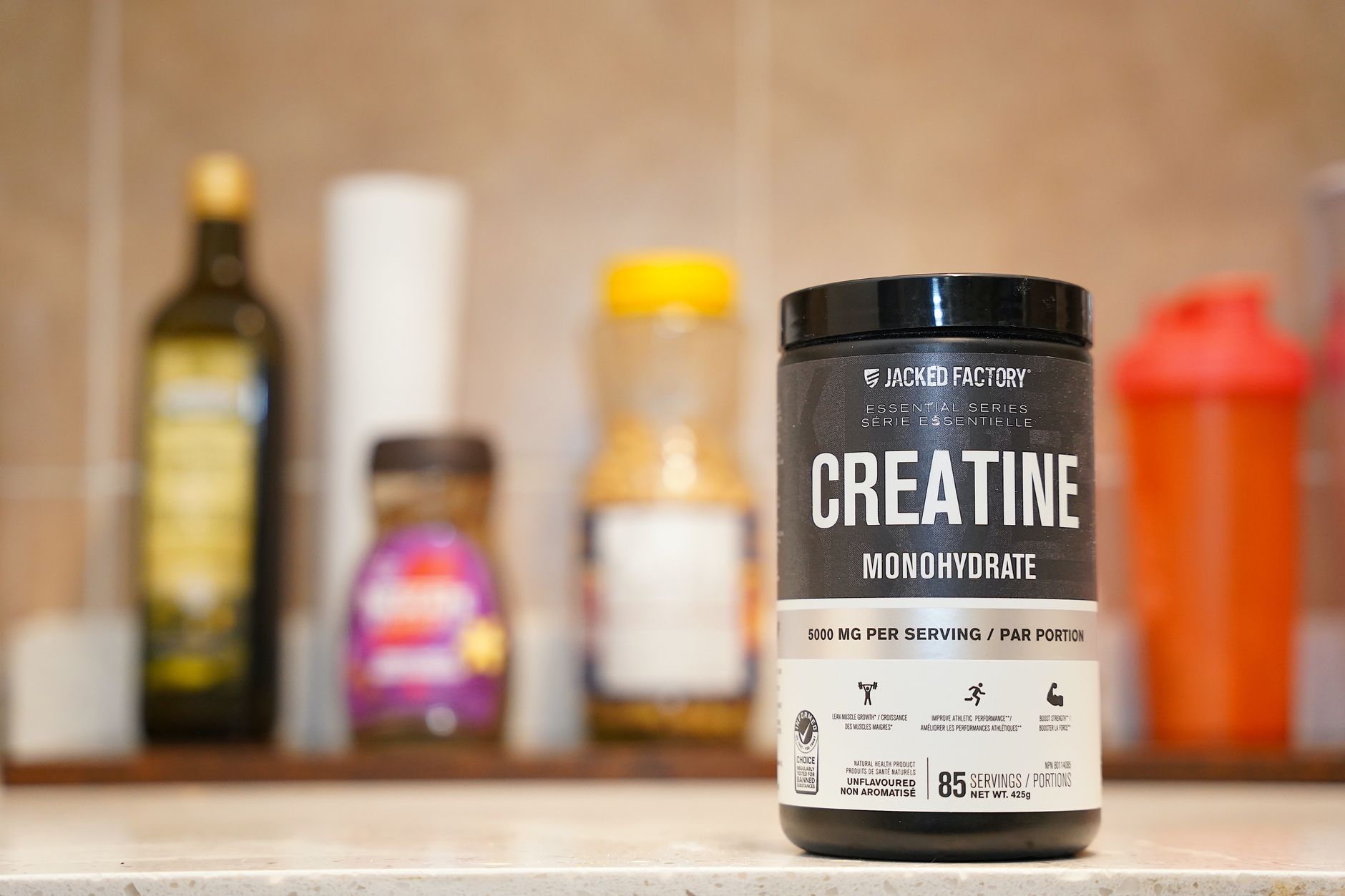
Your brain hoards creatine almost as jealously as your muscles do. Roughly 95 percent of the creatine in your body sits in skeletal muscle, but the remaining sliver powers the most energy-hungry tissue you own, and your neurons treat it like an emergency fuel reserve. That single fact is why a supplement most people file under “stuff for people who deadlift” keeps showing up in aging research.
Creatine has been studied in humans for more than a century and hammered by randomized trials for the last thirty years. Very few things you can buy have that kind of paper trail. The interesting part is not whether it works for muscle. That question is settled. The interesting part is what else it does, and who actually benefits most.
The battery in every cell
Creatine is a small molecule your liver and kidneys make from three amino acids, and you also get about a gram a day from meat and fish. Once inside a cell, it grabs a phosphate group and becomes phosphocreatine. Think of that as a charged battery sitting next to your primary energy currency, ATP.
When a cell burns ATP for a hard, fast effort, it drops to ADP. Phosphocreatine instantly donates its phosphate to recharge that ADP back into ATP. No oxygen required, no waiting for slower metabolic pathways to catch up. This is the system that fires during a heavy set, a sprint, or the first ten seconds of any explosive movement. Supplementing raises the phosphocreatine you have on reserve by roughly 10 to 40 percent, which means more repeats before the battery runs flat.
That same recharging trick matters in the brain, which runs an enormous ATP tab just keeping neurons polarized. When brain energy supply is stressed, whether by sleep loss, low oxygen, or age, having more phosphocreatine on hand appears to help. That mechanism is the thread connecting the muscle data to the cognitive data.
What the trials actually show
For strength and lean mass, the evidence is about as strong as sports nutrition gets. The International Society of Sports Nutrition reviewed the full body of research and concluded creatine monohydrate is the most effective ergogenic supplement available for increasing high-intensity exercise capacity and lean body mass, with a safety record spanning decades of trials J Int Soc Sports Nutr, 2017. Combined with resistance training, it reliably adds a few extra kilograms of lean mass and measurable strength over programs that use training alone.
The reason this matters after 40 is muscle. You lose it with age whether you notice or not, and that loss tracks with frailty, falls, and mortality. Anything that lets an older adult hold onto or rebuild lean tissue is playing in the same league as the case for lifting itself, which we make at /train/strength-training-after-40. Creatine appears to amplify what resistance training already does, and the effect looks at least as large in older trainees as in younger ones.
The brain evidence is younger and less certain, but promising. In vegetarians, whose diets provide almost no dietary creatine, supplementation improved performance on working memory and intelligence tests in a placebo-controlled crossover Proc Biol Sci, 2003. The pattern across studies is consistent: creatine helps cognition most when the brain’s energy state is under pressure, and does little for a well-rested, well-fed person operating at baseline. Do not expect it to make you sharper on a good day. Expect it to blunt the drop on a bad one.
How much, and does timing matter
The loading protocol you may have read about (20 grams a day for a week) is real but optional. It just fills your muscle stores faster. Take a flat maintenance dose every day and you reach the same saturation in three to four weeks, without the bloating some people get from loading.
Dose scales roughly with body size, about 0.03 grams per kilogram of body weight for maintenance.
| Body weight | Daily maintenance dose | Optional loading (5 to 7 days) |
|---|---|---|
| 60 kg / 132 lb | ~2 g | ~15 g split into 3 doses |
| 75 kg / 165 lb | ~3 g | ~20 g split into 4 doses |
| 90 kg / 198 lb | ~3.5 g | ~22 g split into 4 doses |
| 105 kg / 231 lb | ~4 g | ~25 g split into 5 doses |
Buy plain creatine monohydrate. The fancy variants (hydrochloride, buffered, liquid) cost more and have never beaten monohydrate in a head-to-head. Timing barely matters because you are topping up a reservoir, not spiking a level, so take it whenever you will actually remember. With food helps slightly with absorption and stomach comfort. And drink normally, since creatine pulls a little water into muscle cells, which is part of how it works.
Where the worries came from, and where they went
Two fears follow creatine around, and both deserve a straight answer. The kidney concern traces to the fact that creatine raises blood creatinine, a marker doctors use to estimate kidney function. Higher creatine intake mechanically nudges that number up without any actual change in kidney health, and controlled studies in people with healthy kidneys have not shown damage. If you have existing kidney disease, clear it with your doctor first, and tell whoever reads your bloodwork that you supplement so they interpret the creatinine correctly.
The hair loss worry rests on a single small study that reported a rise in DHT, a hormone linked to male-pattern baldness. No study has actually measured hair loss as an outcome and found it. That is a hypothesis that got promoted to folklore.
Where the evidence genuinely runs thin: the long-term brain and neuroprotective claims are built more on mechanism and short trials than on decades of hard endpoints. The muscle case is proven. The cognition case is plausible and improving. Do not let anyone sell you the second as if it were as settled as the first.
If you lift, you were probably going to take it anyway. If you are over 50, do not lift enough, and want one cheap, unglamorous thing that helps your body hold its ground, this is a rare supplement that has earned the bench time.