
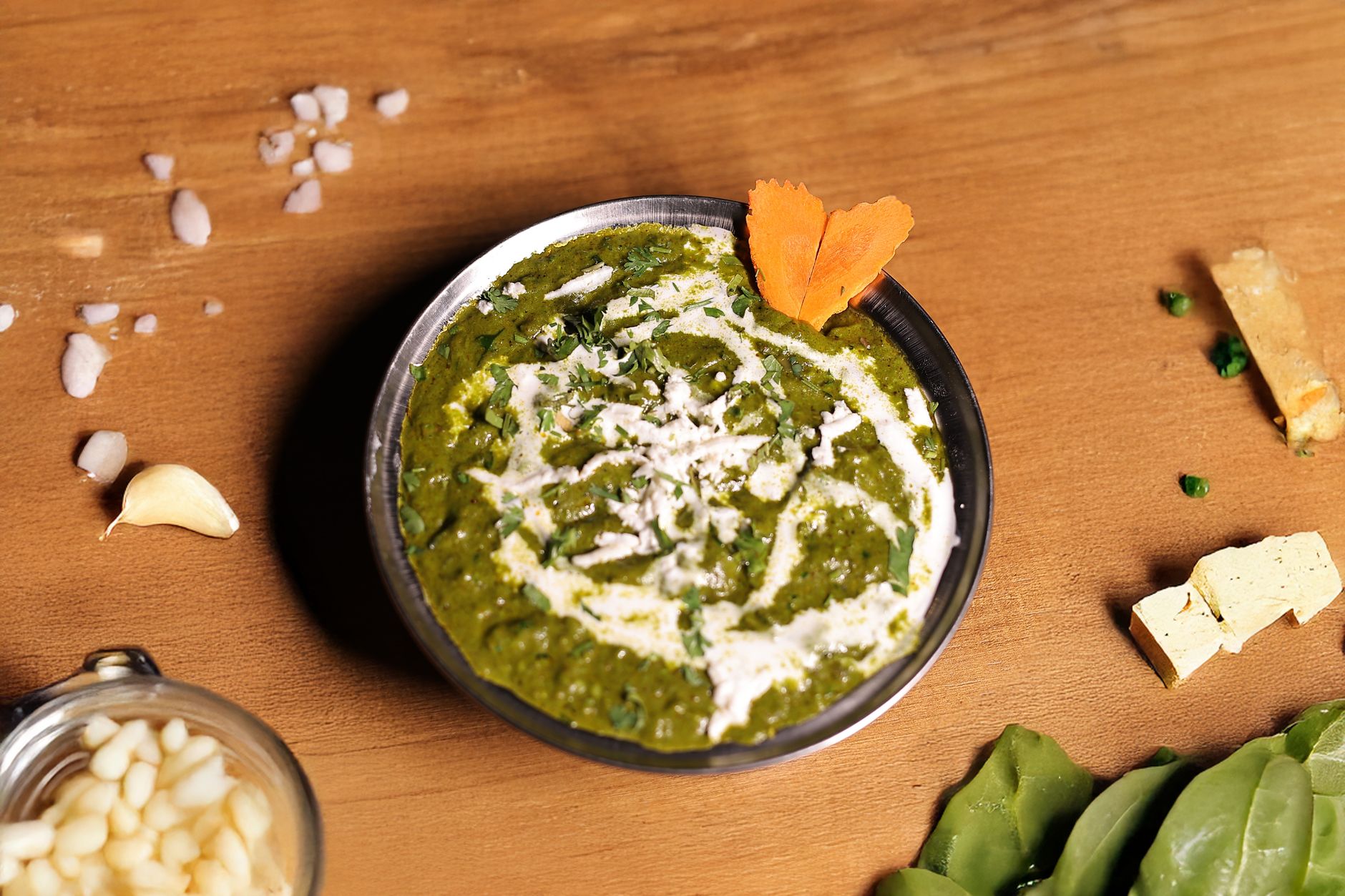
A restaurant palak paneer is usually 40 percent cream and 10 percent food coloring. The green comes from spinach that got boiled to death and blitzed with dairy fat until it looks like pesto. It tastes great and does almost nothing for you.
This version keeps the spinach doing the work. You cook down close to a pound of it, keep it a little coarse instead of pureeing it into oblivion, and finish with a proper tadka of whole cumin bloomed in olive oil. The paneer stays firm because you pan-sear it first. What you get is a curry that carries real spice, holds around 24 grams of protein per serving, and tastes like something instead of tasting like an apology.
The recipe
Makes 4 servings · Active time about 30 minutes · ~320 kcal and 24 g protein per serving
Ingredients
- 400 g paneer, cut into 2 cm cubes (or firm tofu for the leaner version)
- 450 g (about 1 lb) fresh spinach, washed, tough stems removed
- 3 tbsp extra-virgin olive oil, divided
- 1 tsp whole cumin seeds
- 1 large onion, finely chopped
- 6 cloves garlic, minced
- 1 thumb (about 3 cm) ginger, grated
- 1 to 2 green chilies, slit
- 2 medium tomatoes, chopped (or 3 tbsp passata)
- 1 tsp ground turmeric
- 1 tsp ground coriander
- 1/2 tsp garam masala
- 1/4 tsp freshly cracked black pepper (do not skip, this is the piperine)
- Salt to taste
- Juice of half a lemon
- Optional: small handful of dried or fresh methi (fenugreek leaves)
Method
1. Sear the paneer. Heat 1 tbsp olive oil in a wide pan over medium-high. Add the paneer cubes in a single layer and sear until golden on two or three sides, about 3 to 4 minutes total. Lift out and set aside. This is what keeps them firm later; don’t crowd the pan.
2. Wilt the spinach. In the same pan, add the spinach with a splash of water and a pinch of salt. Cover and let it collapse over medium heat, 2 to 3 minutes, stirring once. Transfer to a board and chop it coarsely by hand. Do not puree it. You want texture, not baby food.
3. Build the base. Add the remaining 2 tbsp olive oil to the pan. Drop in the cumin seeds and let them sizzle for 20 seconds until fragrant. Add the onion and cook until deep golden, 6 to 8 minutes. Add garlic, ginger and green chili and cook hard for another 2 minutes until the raw smell is gone and the base browns.
4. Spice and tomato. Stir in turmeric, coriander, garam masala and black pepper, cook for 30 seconds, then add the tomatoes. Cook down until the mixture pulls together and the oil starts to separate at the edges, about 5 minutes.
5. Bring it together. Fold the chopped spinach back in along with the methi if using. Add a splash of water to loosen to your preferred consistency and simmer 3 to 4 minutes. Return the seared paneer, stir gently to coat, and warm through for another 2 minutes. Season with salt.
6. Finish. Kill the heat, squeeze in the lemon, and taste. It should be bright and a little sharp, not flat. Serve.
Tip: For a creamier gravy that stays high-protein, blend a few tablespoons of cottage cheese into the spinach off the heat instead of reaching for cream.
Nutrition per serving (roughly)
- Calories: 320 kcal
- Protein: 24 g
- Carbs: 12 g
- Fiber: 6 g
- Fat: 20 g (about 8 g saturated, from the paneer)
Swapping tofu for paneer drops it to around 250 kcal and 5 g saturated fat.
Storage and reheating
Keeps in the fridge for four days and, unusually for a spinach dish, tastes better on day two once the spices settle. Reheat gently on the stove with a splash of water; the microwave works but can toughen the paneer, so pull it a little early. It freezes for up to three months, though the spinach texture softens, so freeze it if you plan to eat it as a sauce over rice rather than as a chunky curry.
Variations worth making
- Fold in a handful of cooked brown or green lentils at the end to push protein past 30 g a serving and add fiber.
- Add a charred green chili and a squeeze of lemon at the table. The acid is what makes it taste finished.
- If you have methi (fenugreek leaves), a small handful stirred in gives the bitter, savory edge that separates a home cook’s version from a canteen one.
Eat it with a whole-wheat roti or a scoop of brown rice, not because refined carbs are evil, but because the fiber turns a good bowl into one your gut and your blood sugar both notice.
What the four ingredients that matter are actually doing
Spinach is the reason this dish exists, and not for the iron you were told about as a kid. Dark leafy greens are dense in nitrate, lutein, folate and vitamin K, and in a large prospective cohort, older adults who ate roughly one serving of leafy greens a day showed cognitive function equivalent to being 11 years younger than those who ate almost none Neurology, 2018. That is association, not proof, but the mechanism (nitrate to nitric oxide, better blood flow, plus lutein deposited directly in neural tissue) is coherent. Cooking spinach down concentrates all of it into a few forkfuls.
Paneer is the protein spine. It is a fresh, non-melting cheese, essentially milk curdled with acid, so it is mostly casein plus a little residual fat. Casein digests slowly and delivers a steady drip of amino acids, which is why it holds its shape in a simmering gravy where mozzarella would turn to string. If you want the dish leaner, you can swap in firm tofu one-for-one; it takes spice almost as well and drops the saturated fat, though it loses paneer’s characteristic squeak.
Garlic and ginger are not just aromatics here, they are cooked hard at the base so their sugars brown and deepen. Garlic specifically has a blood-pressure signal: a meta-analysis of controlled trials found garlic supplementation lowered systolic pressure by roughly 8 mmHg in people who were hypertensive to begin with BMC Cardiovasc Disord, 2008. You are not eating a supplement dose in one bowl, but the habit adds up.
Turmeric is in nearly every Indian gravy, and its active compound curcumin is famously hard for the body to absorb. The classic fix is in the recipe already: black pepper. Piperine from pepper increased curcumin bioavailability by about 2000 percent in a controlled human study Planta Med, 1998. This is why the pinch of pepper is not optional and why turmeric-in-warm-water trends are mostly wasted turmeric.
The whole plate also sits squarely in the Mediterranean pattern once you cook it in olive oil instead of ghee: vegetables and dairy protein doing the heavy lifting, no red meat, acid and spice instead of a cream reduction. That pattern cut major cardiovascular events by about 30 percent in a randomized trial of over 7,000 people N Engl J Med, 2018.
On ghee versus olive oil
Traditional palak paneer uses ghee, and ghee tastes wonderful. Extra-virgin olive oil works cleanly here and shifts the fat toward monounsaturates and polyphenols without wrecking the dish, because the spice and the greens are carrying the flavor, not the fat. If you want one spoon of ghee in the final tadka for aroma, take it. Do not pretend the whole thing needs four.
How much protein you actually need
The old 0.8 g/kg figure is a floor to prevent deficiency, not a target for someone who lifts or wants to hold muscle into their seventies. Here is a more useful frame.
| Who you are | Daily target (per kg) | Per meal |
|---|---|---|
| Sedentary adult, minimum | 0.8 g | 20 g |
| Active adult | 1.2 to 1.6 g | 30 g |
| Training for strength | 1.6 to 2.2 g | 35 to 40 g |
| Adult over 65 | 1.2 to 1.5 g | 30 g+ (leucine matters more) |
One serving of this gives you about 24 g. Serve it with a cup of Greek yogurt on the side or a small bowl of dal and you clear 35 g without touching meat. See /fuel/protein-the-bodys-building-block for why the per-meal distribution matters more than the daily total.