
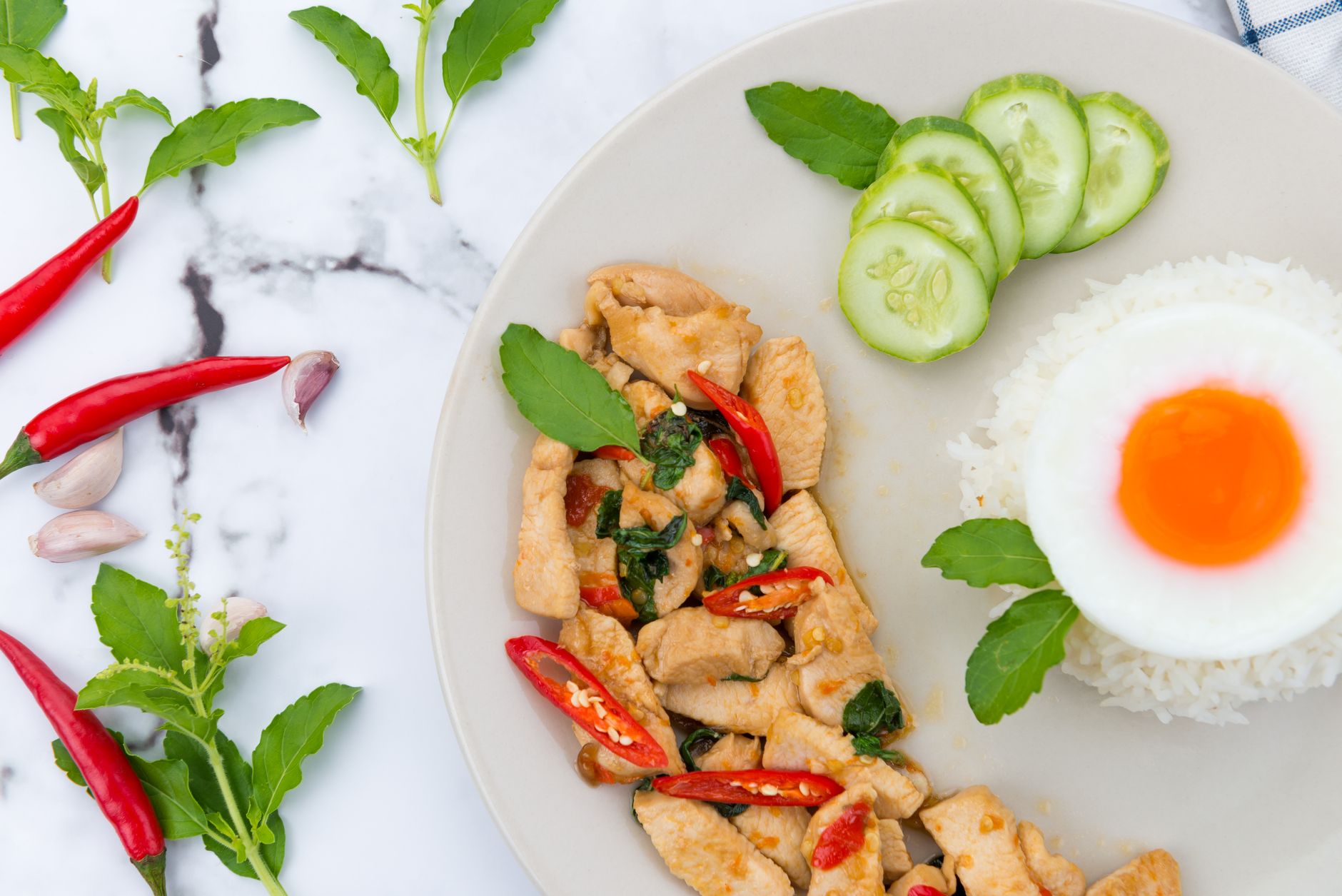
In Thailand this is the dish you order when you can’t decide what to order. Pad krapow gai is the default, the thing a cook can make with their eyes closed, and it happens to be one of the highest-return dinners you can put on a weeknight table: chicken, garlic, chili, and holy basil hit with fish sauce, on the plate in under 20 minutes.
I’m making the low-carb version here. Traditionally it comes over jasmine rice with a fried egg, and the egg stays because a runny yolk over spicy basil chicken is one of the great small pleasures. But the rice is optional, and the dish loses nothing served over a pile of quickly charred green beans or cauliflower rice. The flavor lives in the sauce and the basil, not the starch.
What makes it fast, and why thighs
The whole thing is a hot-pan job. You want the wok or a heavy skillet screaming, the chicken chopped small so it cooks in three minutes, and everything else prepped in little bowls before you turn the heat on. There is no simmer, no marinade, no resting. That is the point.
Use boneless, skinless chicken thighs and chop them by hand into rough pieces rather than buying ground chicken. Hand-chopped thigh keeps a bit of texture and stays juicy where ground breast turns to sand. Thigh has more intramuscular fat, which means it forgives you if the pan runs a few seconds long, and it carries chili and garlic better than breast ever will. You still get a serious protein load: this comes in around 38 grams a serving. Higher-protein meals blunt hunger more per calorie than carb-heavy ones and better protect lean mass, which is the whole longevity game as you age (Am J Clin Nutr, 2015).
The four things carrying the flavor
Fish sauce is the backbone. It is fermented anchovy, which means it delivers glutamate and a savory depth that no amount of salt alone can fake. This is the same fermented-umami trick behind miso and soy, and it’s what makes the dish taste finished rather than merely seasoned. Don’t be shy with it.
Garlic, and a lot of it, browned properly at the edge of the pan until it’s golden and fragrant, not raw. Beyond flavor, garlic’s sulfur compounds have a modest but real effect on blood pressure across controlled trials (BMC Cardiovasc Disord, 2008). One dinner won’t move your numbers, but garlic earns its place on the plate several ways.
Thai chilies bring the heat and the point. The active compound, capsaicin, is more than a sensation: in a large Chinese cohort, people who ate spicy food six or seven days a week had a 14 percent lower risk of death over the study period than those who ate it less than once a week (BMJ, 2015). That’s an association from an observational study, not a promise, but it fits a pattern where chili-eating populations do well.
Holy basil (or Thai basil if that’s what your store has) goes in raw at the very end and wilts in the residual heat. This is the raw-herb finish that separates a good stir-fry from a great one. It should taste bright and almost peppery against the salty, garlicky base.
The olive oil note: authentically this is cooked in a neutral high-heat oil, and that’s the right call for a proper sear at wok temperature. This is one dish where I wouldn’t reach for extra-virgin, since its low smoke point fights the technique. Avocado oil or a light neutral oil is the honest choice here.
Approximate nutrition per serving
Based on three servings, over vegetables rather than rice: roughly 360 calories, 38 g protein, 9 g carbohydrate, about 4 g fiber, and 19 g fat. Add a fried egg and you’re at about 430 calories and 44 g protein. Add half a cup of jasmine rice and it becomes a smart-carb meal instead, closer to 470 calories with 33 g of carbs, which is a fine choice on a training day.
Storage, reheating, and the variations
This reheats better than most stir-fries because thigh meat doesn’t dry out. Keep it in the fridge up to three days and reheat in a hot pan for two minutes rather than the microwave, which steams the basil to mush. Add a few fresh basil leaves at the end of reheating to wake it back up.
Swap the protein freely. Shrimp works and cooks even faster, in about two minutes. Ground pork is the other classic. For a vegetarian night, crumbled firm tofu, pressed and browned hard, takes the sauce well. If you want more vegetables in the pan, long beans or green beans are traditional and add crunch. For a bigger green plate, see the approach in our Greek shrimp saganaki for how a fast skillet protein anchors a vegetable-forward dinner.
One rule worth keeping: taste before you add extra fish sauce at the end. Between the sauce, the chili, and the garlic, it’s easy to overshoot the salt, and the fix is a squeeze of lime, not more sauce. Acid is what pulls the whole thing into focus.