
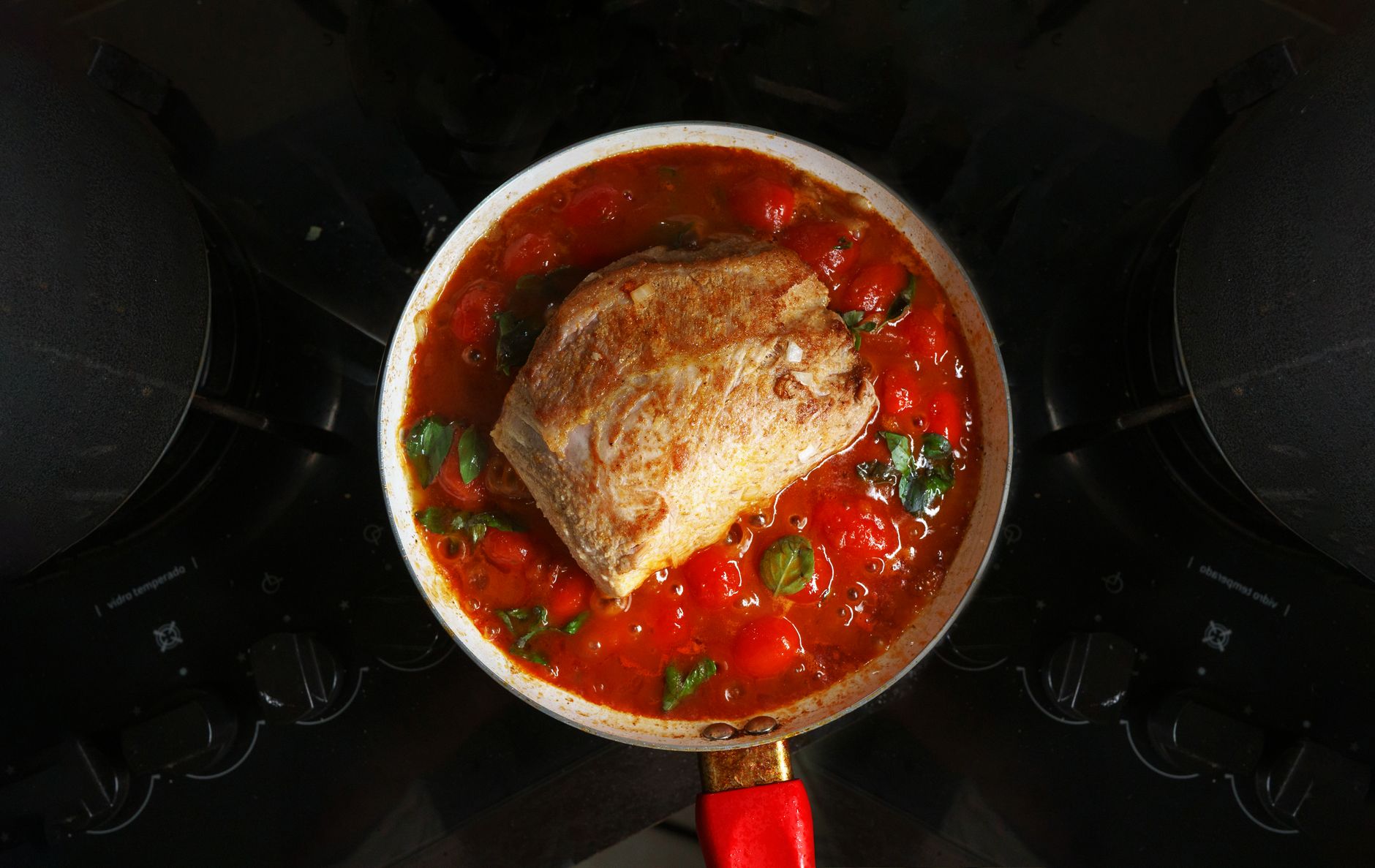
Most “healthy fish” recipes fail at the same spot: they poach a fillet in something pale and call the lack of flavor virtue. Chraime does the opposite. It buries mild white fish in a sauce loud enough that you forget you’re eating the sensible thing. This is the Jewish-North African fish dish traditionally served on Friday nights across Libya and Tunisia, and it is built on garlic, chili, cumin, caraway, and enough olive oil to carry all of it.
It is low-carb by design. The whole plate leans on fish, peppers, tomato, and fat, with the only real carbohydrate coming from the tomatoes themselves. And it lands on the table in about 30 minutes, most of which is unattended simmering while you do something else.
What the sauce is actually doing
Chraime is a braise disguised as a stew. You build a deep, oily tomato-pepper base first, then slide raw fish into it to poach gently. That matters for texture: cod dropped into a hot dry pan overcooks in the time it takes to turn around, but cod finished in a barely-bubbling sauce stays in flakes that hold together instead of shredding. The sauce protects it.
The flavor is front-loaded into fat. Ground cumin, caraway, and paprika get bloomed in warm olive oil before anything wet goes in, which is the step that separates a dish that tastes like spices from one that tastes of dust. Fat-soluble aromatics need fat and heat to release, so 60 seconds in the oil is doing real work.
The ingredients pulling their weight
Cod (or any firm white fish). This is the everyday protein the Mediterranean pattern is built on: lean, high in protein, low in saturated fat, and a source of the marine omega-3s that fish delivers and almost nothing else in a normal diet does. A large review weighing the benefits against contaminant risk concluded that for most adults the cardiovascular upside of eating fish regularly clearly outweighs the risks JAMA, 2006. Cod is mild enough to act as a sponge for the sauce, which is exactly what you want here. Grouper, halibut, or even salmon all work if that’s what the counter has.
Olive oil, and a real amount of it. This is not a garnish drizzle. A quarter cup goes into the sauce because it is both the cooking medium and the flavor carrier. Extra-virgin olive oil as the default fat is the single most tested piece of the Mediterranean pattern: in the PREDIMED trial, a Mediterranean diet supplemented with extra-virgin olive oil cut major cardiovascular events compared with a low-fat control N Engl J Med, 2013. Do not use a light or refined oil here to save calories. The dish needs it.
Chili and harissa. The heat is the point, not a personality quirk. In a large Italian cohort, adults who ate chili pepper four or more times a week had lower all-cause and cardiovascular mortality than those who rarely ate it, independent of the overall diet quality J Am Coll Cardiol, 2019. That is an association in an observational study, not proof that capsaicin saves your heart, but it is a reason to lean into the spice rather than apologize for it.
Garlic, sliced not minced. Eight cloves sounds aggressive and isn’t. Sliced garlic mellows and almost candies in the oil, giving the sauce body without the sharp raw bite. Allicin, the compound formed when garlic is cut, is what gives it its pungency and most of its studied bioactivity; letting the slices sit a couple of minutes before they hit the oil lets that chemistry happen.
Tomato paste plus crushed tomatoes. The paste is concentrated, browned depth; the crushed tomatoes are the body. Cooking tomatoes in fat increases the bioavailability of lycopene, the carotenoid responsible for the red color, because it is fat-soluble and heat makes it more absorbable. That’s mechanism, not a health claim, but it is a good reason this dish uses both fat and heat generously.
Lemon and cilantro at the end. This is the finish that makes it taste finished. Acid resets a rich, oily sauce, and raw herb on top gives contrast against the cooked depth underneath. Skip it and the dish tastes heavy. Add it and it tastes bright.
Approximate nutrition per serving
For four servings: roughly 310 calories, 34 g protein, 17 g fat, about 9 g total carbohydrate and 6 g net carbs, and 2 g fiber. Squarely low-carb, and the fat is almost entirely olive oil and fish.
Getting it on the table
The timing trap is the fish. White fish is done when it turns opaque and flakes with light pressure, which for inch-thick cod is 8 to 12 minutes in a gently simmering sauce. Keep the heat low once the fish is in. A hard boil will toughen it and break it apart. If your fillets are thin, check at 6 minutes.
Salt the fish before it goes in, not just the sauce. Seasoning the surface of the fillet directly is the difference between fish that tastes seasoned and fish sitting in seasoned sauce.
Storage, reheating, and variations
Chraime keeps beautifully for three to four days in the fridge and arguably tastes better on day two, once the spices settle into the sauce. Reheat gently in a covered pan over low heat so the fish doesn’t seize; the microwave works but tends to overcook the edges. It does not freeze as well as a pure sauce, because the fish texture suffers, so if you want to batch it, freeze the sauce alone and cook fresh fish into it later.
For a smart-carb version, spoon it over a bed of whole-grain couscous or serve with a torn piece of whole-wheat flatbread to drag through the sauce, which is the traditional way and turns it from a low-carb plate into a proper meal. Chickpeas simmered in the sauce add fiber and make it more of a one-pot dinner. If you want it milder for a table with kids, pull the fresh chili and lean on paprika, keeping the harissa on the side. And if you like the Mediterranean-fish rotation, this sits naturally next to a miso-glazed cod or a gochujang salmon on a weeknight.
Made twice, it stops being a recipe you follow and becomes one you eyeball. That is the real test, and this one passes.